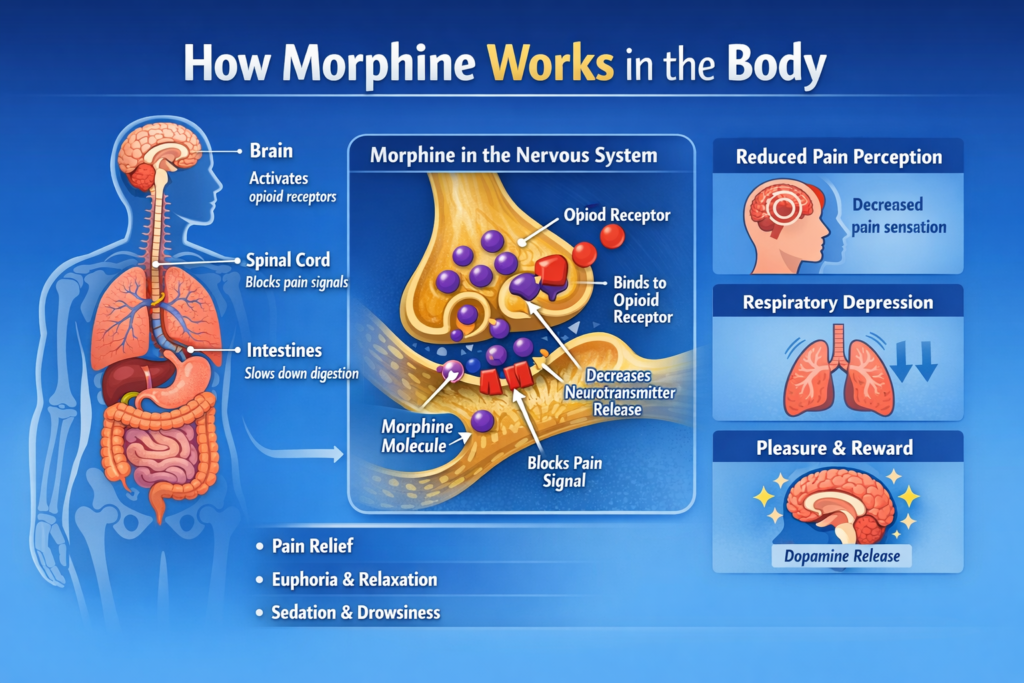
The Morphine Mechanism of Action
The morphine mechanism of action centers around its interaction with opioid receptors in the body. These receptors are proteins found in the brain, spinal cord, and other parts of the nervous system.
There are three major types of opioid receptors:
- Mu (μ) receptors
- Delta (δ) receptors
- Kappa (κ) receptors
Among these, the mu-opioid receptor is the most important for opioid pain relief.
When morphine enters the bloodstream, it travels to the brain and binds to these receptors. This binding triggers chemical changes that reduce the transmission of pain signals.
The morphine mechanism of action works through several biological processes:
- Blocking pain neurotransmitters
- Reducing nerve signal transmission
- Altering pain perception in the brain
Because of these effects, understanding How Morphine Works in the Body helps explain why morphine is considered one of the most powerful analgesic medications used in hospitals today.
How Morphine Works in the Brain
One of the most important aspects of How Morphine Works in the Body involves its impact on the brain.
After entering the bloodstream, morphine crosses the blood–brain barrier, allowing it to reach pain-processing centers in the brain. Once there, it activates opioid receptors in several key regions.
Important brain areas affected include:
- The thalamus, which processes sensory signals
- The limbic system, which regulates emotional responses to pain
- The brainstem, which controls basic bodily functions
Through the morphine mechanism of action, morphine reduces the brain’s perception of pain. Patients often experience significant opioid pain relief because the brain receives fewer pain signals from injured tissues.
Research on How Morphine Works in the Body shows that morphine not only blocks physical pain signals but also changes the emotional response to pain.
This dual effect explains why morphine is often discussed in relation to Morphine Uses for Severe Pain in clinical medicine.
How Morphine Works in the Spinal Cord
Another important element of How Morphine Works in the Body occurs in the spinal cord.
The spinal cord acts as a communication highway between the body and the brain. Pain signals must pass through this pathway before reaching the brain.
Morphine interferes with this process through the morphine mechanism of action.
When morphine binds to opioid receptors in the spinal cord, it:
- Reduces neurotransmitter release
- Blocks nerve communication
- Limits signal transmission to the brain
This process significantly contributes to opioid pain relief because fewer pain signals are able to travel upward to the brain.
Understanding How Morphine Works in the Body shows that morphine affects both central and peripheral nervous system pathways.
Absorption and Distribution of Morphine
The way morphine moves through the body also plays an important role in How Morphine Works in the Body.
Morphine can be administered in several forms, including:
- Oral tablets
- Intravenous injections
- Epidural injections
- Controlled-release capsules
Once administered, morphine is absorbed into the bloodstream and distributed throughout the body.
The morphine mechanism of action begins once the drug reaches opioid receptors in the nervous system.
Several factors influence how quickly morphine works, including
- Metabolic rate
- Age and body weight
- Liver function
- Kidney function
These variables affect how long opioid pain relief lasts and how the drug behaves in the body.
Metabolism and Elimination
Another key component of How Morphine Acts in the Body involves how the drug is processed and removed.
Morphine is primarily metabolized in the liver, where enzymes convert it into active metabolites. Two of the most important metabolites are
- Morphine-3-glucuronide
- Morphine-6-glucuronide
These metabolites contribute to the overall morphine mechanism of action, sometimes extending the duration of opioid pain relief.
After metabolism, the kidneys remove these substances from the body through urine.
Because metabolism affects drug concentration, doctors carefully control morphine dosing in clinical settings.
Tolerance and Physiological Adaptation
Repeated use of morphine can lead to tolerance, meaning the body becomes less responsive to the drug over time.
Tolerance is an important concept when studying How Morphine Works in the Body.
It occurs when opioid receptors adapt to repeated stimulation. As a result, the same dose may produce less opioid pain relief than before.
The morphine mechanism of action plays a role in this process because the nervous system gradually changes how it responds to opioid receptor activation.
Healthcare providers carefully monitor patients to ensure safe and effective pain management.
Side Effects Related to Morphine’s Mechanism
Because morphine affects multiple body systems, it can produce side effects related to its biological activity.
Common side effects include:
- Drowsiness
- Constipation
- Nausea
- Slowed breathing
These effects occur because opioid receptors exist in many areas beyond pain pathways.
Understanding How Morphine Acts in the Body helps explain why these side effects occur.
Despite these potential effects, opioid pain relief remains a critical tool in medical care when used responsibly under medical supervision.
The Role of Morphine in Modern Pain Management
Although many new pain medications have been developed, morphine continues to play a major role in hospital pain treatment.
The reason lies in the well-understood morphine mechanism of action, which provides reliable and effective opioid pain relief for patients experiencing intense pain.
Medical research into How Morphine Works in the Body continues to improve how healthcare providers use morphine safely.
Scientists are currently studying:
-
Improved opioid delivery systems
-
Non-addictive pain medications
-
Safer opioid receptor targeting drugs
These advancements aim to maintain effective pain relief while reducing potential risks.
What is the action of morphine?
Morphine is a powerful opioid analgesic that acts on the central nervous system by binding to opioid receptors (mainly mu receptors) in the brain and spinal cord. It helps alleviate moderate to severe pain by blocking pain signals and altering the perception of pain.
It also produces effects such as strong analgesia, euphoria, sedation, respiratory depression, miosis (pupil constriction), and reduced cough reflex (antitussive action).
Mechanism of Action of Morphine (in points):
- Morphine binds to mu-opioid receptors in the brain, spinal cord, and other parts of the central nervous system.
- It inhibits transmission of pain signals by blocking neurotransmitter release (like substance P).
- It causes hyperpolarization of nerve cells, making them less likely to transmit pain impulses.
- It alters pain perception and emotional response, reducing the feeling of discomfort.
- It helps alleviate moderate to severe pain by acting directly on the CNS.
- It also produces effects such as analgesia, sedation, euphoria, respiratory depression, miosis, and antitussive action.
Conclusion
Understanding How Morphine Works in the Body reveals why this medication has remained a critical part of medical pain management for decades. Through its interaction with opioid receptors in the brain and spinal cord, morphine reduces the transmission of pain signals and alters how the brain perceives pain.
The morphine mechanism of action involves complex neurological processes that block pain pathways, decrease neurotransmitter activity, and provide powerful opioid pain relief.
Although medical discussions frequently focus on Morphine Uses for Severe Pain, the true effectiveness of morphine lies in its biological interaction with the nervous system.
As research continues, scientists hope to develop safer and more targeted pain treatments. However, the insights gained from studying How Morphine Works in the Body will continue to shape the future of pain management.